
Penalties for false whistleblower report in EU
Penalties for knowingly false whistleblower reports run from nothing at all to a 300,000 EUR fine or a prison term, and which one a reporter faces depends entirely on the country. Spain can fine a false reporter up to 300,000 EUR. Six member states impose no penalty and simply take the protection away. The figures come from our 2026 report on the EU Whistleblower Directive, which compares all 27 national laws. Here is what a false report costs in each country, and what the law still protects.
Key facts
- The sanction ranges from no penalty in six states to 300,000 EUR in Spain.
- Nine states can jail a false reporter or impose a criminal fine; twelve use an administrative fine.
- Six states set no penalty at all and only withdraw protection.
- An honest report that turns out wrong stays protected. Only a knowingly false one is punished.
- The directive demands a penalty but lets each country choose its form.
What the law asks of a whistleblower
Protection rests on one test: a reasonable belief, at the time of reporting, that what you report is true. It does not rest on being right. A report that later proves wrong still keeps its protection, as long as the person had good reason to believe it. Motive does not matter in most states either. Italy says so in as many words, and most others follow the same standard without comment.
The line the law draws is the knowingly false report. Someone who invents an allegation, or repeats one they know to be untrue, falls outside protection and can be sanctioned. That is a narrow gate. It catches the liar, not the colleague who got the facts wrong in good faith.
"No state conditions protection on the report turning out to be true, only on what the reporter reasonably believed when making it."
WeMoral, 2026 Report on Whistleblower Directive Transposition Across the EU, p. 4
What a knowingly false whistleblower report can cost
Where a penalty exists, the amounts are far apart. Spain sets the heaviest exposure in the EU, a fine of 30,001 to 300,000 EUR that would bankrupt most individual reporters and sits an order of magnitude above the next tier. Ireland can reach 100,000 EUR and two years in prison, and adds a separate claim for anyone the false report harmed. Luxembourg combines up to 50,000 EUR with a short prison term. Greece is harshest on the custodial side, requiring at least two years' imprisonment.
At the other end the figures turn almost symbolic. Latvia's ceiling is 700 EUR. Slovenia runs a band of 400 to 1,200 EUR, and Italy 500 to 2,500 EUR with mandatory discipline on top. Austria and Germany both cap the fine at 20,000 EUR. Czechia works out at about 2,000 EUR and Estonia at 2,400 EUR.
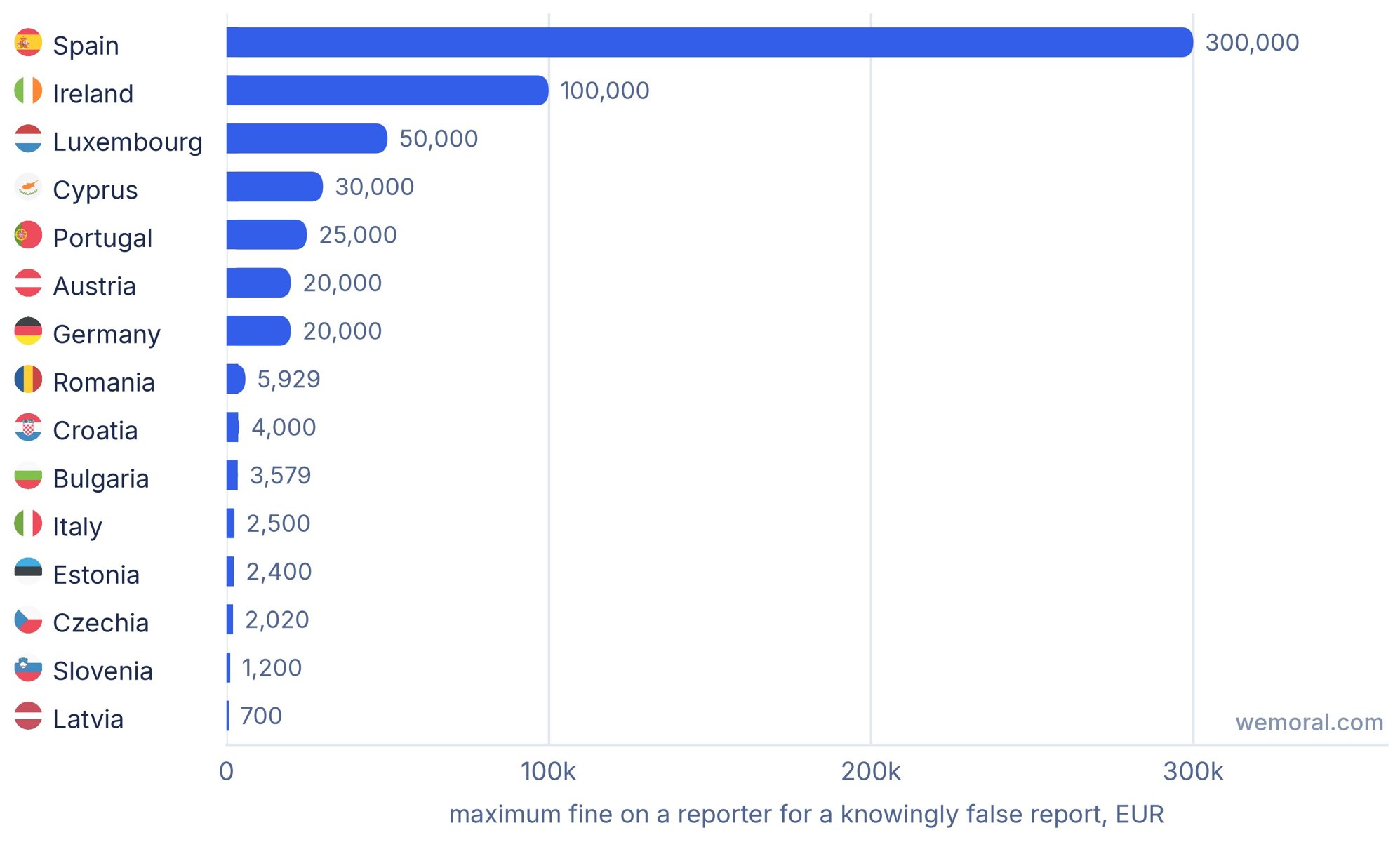
Source: WeMoral, 2026 Report on Whistleblower Directive Transposition Across the EU, p. 37.
The table below sets out what each of the 27 states does with a reporter who lies. Money, prison, or nothing but the loss of protection.
| Country | Sanction for a knowingly false report |
|---|---|
 Austria Austria | Up to 20,000 EUR |
 Belgium Belgium | Criminal defamation regime |
 Bulgaria Bulgaria | About 1,500 to 3,600 EUR |
 Croatia Croatia | 600 to 4,000 EUR |
 Cyprus Cyprus | Up to 30,000 EUR or 3 years' prison |
 Czechia Czechia | Up to about 2,000 EUR |
 Denmark Denmark | Criminal fine, set by the court |
 Estonia Estonia | Up to 2,400 EUR |
 Finland Finland | Criminal fine, set by the court |
 France France | No fine, protection is lost |
 Germany Germany | Up to 20,000 EUR |
 Greece Greece | At least 2 years' prison |
 Hungary Hungary | None |
 Ireland Ireland | Up to 100,000 EUR and 2 years' prison |
 Italy Italy | 500 to 2,500 EUR, plus discipline |
 Latvia Latvia | 30 to 700 EUR |
 Lithuania Lithuania | No fine, guarantees are lost |
 Luxembourg Luxembourg | 8 days to 3 months' prison and up to 50,000 EUR |
 Malta Malta | Criminal prosecution |
 Netherlands Netherlands | None |
 Poland Poland | Up to 2 years' prison |
 Portugal Portugal | 1,000 to 25,000 EUR |
 Romania Romania | About 500 to 5,900 EUR |
 Slovakia Slovakia | No fine, protected status is lost |
 Slovenia Slovenia | 400 to 1,200 EUR |
 Spain Spain | 30,001 to 300,000 EUR |
 Sweden Sweden | None |
Source: WeMoral, 2026 Report on Whistleblower Directive Transposition Across the EU, p. 34.
Criminal or administrative penalties for a false whistleblower report
The amount is only part of the story. The route matters as much, because a criminal record follows a person in a way a fine does not. Twelve states treat a false report as an administrative matter and answer it with a fine. Nine go criminal, with a prison term or a criminal fine: Belgium, Cyprus, Denmark, Finland, Greece, Ireland, Luxembourg, Malta and Poland. Six impose no penalty and let the loss of protection stand as the whole consequence: France, Hungary, Lithuania, the Netherlands, Slovakia and Sweden.
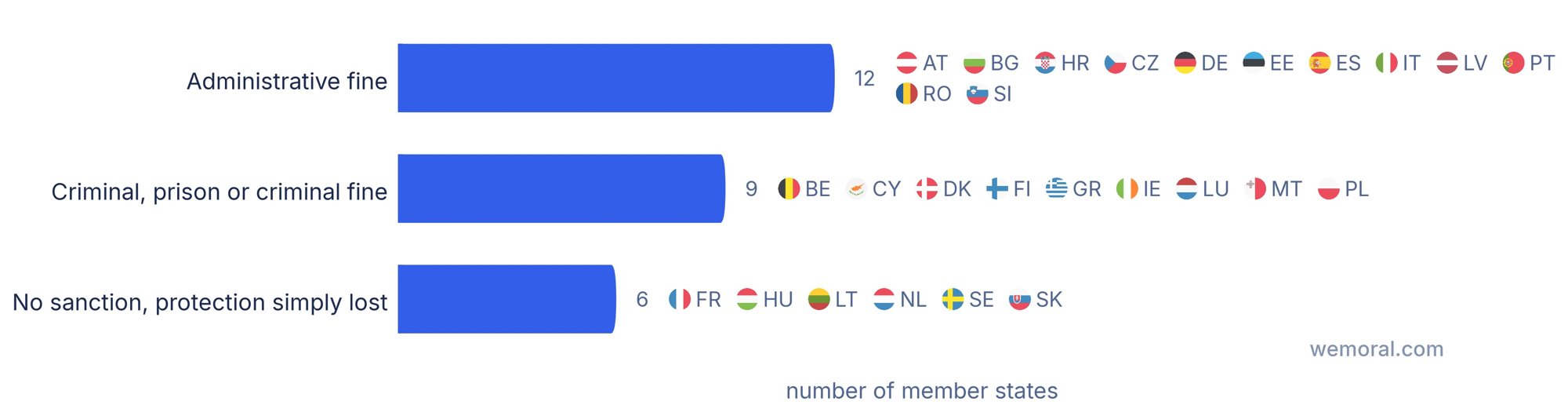
Source: WeMoral, 2026 Report on Whistleblower Directive Transposition Across the EU, p. 36.
Luxembourg is the odd case. Its criminal provision points only at the reporter, not at the employer, so a false reporter there faces prison while a company that breaks the rules faces only an administrative fine. That is the mirror image of what companies risk. What a business pays for ignoring its own duties sits in our post on company fines by EU country, where Spain again tops the scale.
The standard a whistleblower report must meet
Most states ask the same thing of a reporter: reasonable belief, motive aside. Nine write the standard down in a way worth reading before you rely on it. France and Portugal require good faith, and Portugal adds serious grounds on top. Lithuania wants reasonable belief plus a public-interest purpose. Latvia asks for belief backed by reasonable suspicion and attaches two disqualifiers. Slovakia presumes good faith until someone disproves it.
For an employer running one channel across borders, this means a single admissibility test does not fit every report. The same report can clear the bar in one country and fall short in another. If you are not sure who even counts as a protected reporter, our guide on who is a whistleblower sets out the boundaries.
| Country | Standard the reporter must meet |
|---|---|
| France | Good faith |
| Greece | Reasonable belief, measured objectively |
| Ireland | Motive is not a condition |
| Italy | Reasonable belief, motive expressly irrelevant |
| Latvia | Belief plus reasonable suspicion, two disqualifiers |
| Lithuania | Reasonable belief and a public-interest purpose |
| Portugal | Good faith and serious grounds |
| Slovakia | Good faith, presumed until disproved |
| Slovenia | Reasonable belief, expressly not good faith |
Source: WeMoral, 2026 Report on Whistleblower Directive Transposition Across the EU, p. 24.
Does the risk of a penalty stop honest whistleblower reports?
There is a real worry here. If a reporter fears a fine, they may keep quiet about a genuine concern rather than risk being wrong. Spain's 300,000 EUR ceiling is the clearest example. It is high enough to ruin an individual, and it sits far above every other country, so a Spanish worker weighing a report carries a risk a German or a Latvian one does not.
The design of the law softens that worry, though. Every one of these penalties reaches only the knowingly false report. An honest mistake is protected in all 27 states, and the burden of proving bad faith falls on the employer, not the reporter. Six states impose no penalty on a false reporter at all. For most workers, in most countries, the honest concern is safe to raise. Our post on whether whistleblowing is safe looks at that balance in full.
How 27 member states transposed Directive 2019/1937, and where their laws still disagree on fines, anonymity, deadlines and protection.
Get full report for free nowThe practical lesson for an employer is to say this out loud. A reporter who understands that an honest report cannot be punished, only a lie, is far more likely to come forward. Silence about the rules breeds the exact fear the penalty was never meant to cause.
Build a whistleblowing culture on good faith, not fear
The false-report penalty is the part of the law most likely to be misread, by the company and the reporter alike. Read at face value it looks like a threat. Read properly it is a narrow rule that punishes lying and leaves honest reporting untouched. The countries that get the most out of their channels are the ones that explain the difference, not the ones that lean on the fine. Tell your people the truth: report what you honestly believe, and the law is on your side. Check your own countries' rows before you decide how to word it.

Compliance specialist focused on policy roll-out and internal information flow. Writes on EU rule-making, landmark cases, and implementing reporting software.