
Anonymous whistleblowing in EU: from mandatory to banned
Anonymous whistleblowing rules by EU country run from mandatory to banned. One law, Directive 2019/1937, was meant to set a single standard. It did not. Whether a worker can report without giving a name now depends on the country. Three countries make a company accept anonymous reports. Three others bar or exclude them. We read all 27 national laws for our 2026 report on the EU Whistleblower Directive. Here is where each country stands.
Key facts
- Only 3 of 27 states make companies accept anonymous reports: Spain, Portugal, and Belgium's larger private firms.
- Three states bar or exclude anonymous reports: Bulgaria, Latvia and Malta.
- 12 states permit anonymous reports but force no one to accept them.
- A group that runs one channel across the EU must design for the strictest country it works in.
How do EU countries treat anonymous reports?
The Directive left anonymity to national law. That one choice split the EU more than any other rule we measured. There are eight positions across 27 states, but three camps hold most of them. Twelve states permit anonymous reports yet force no one to accept them. This is what the Directive itself does. Three states go further and make it a duty. Three more shut the door. They either bar such reports or leave the reporter with no protection.
The rest sit in smaller groups. Cyprus, Greece and Italy do not cover anonymity at all. They protect only the reporter who is named later. Denmark, Estonia and Sweden never use the word in the law. France allows it in general but requires it only in finance. The Netherlands wrote a rule for it and never put it in force. Finland takes anonymous reports on its internal channel, but its external body refuses them. So a Finnish reporter who wants to stay anonymous cannot take the case higher.
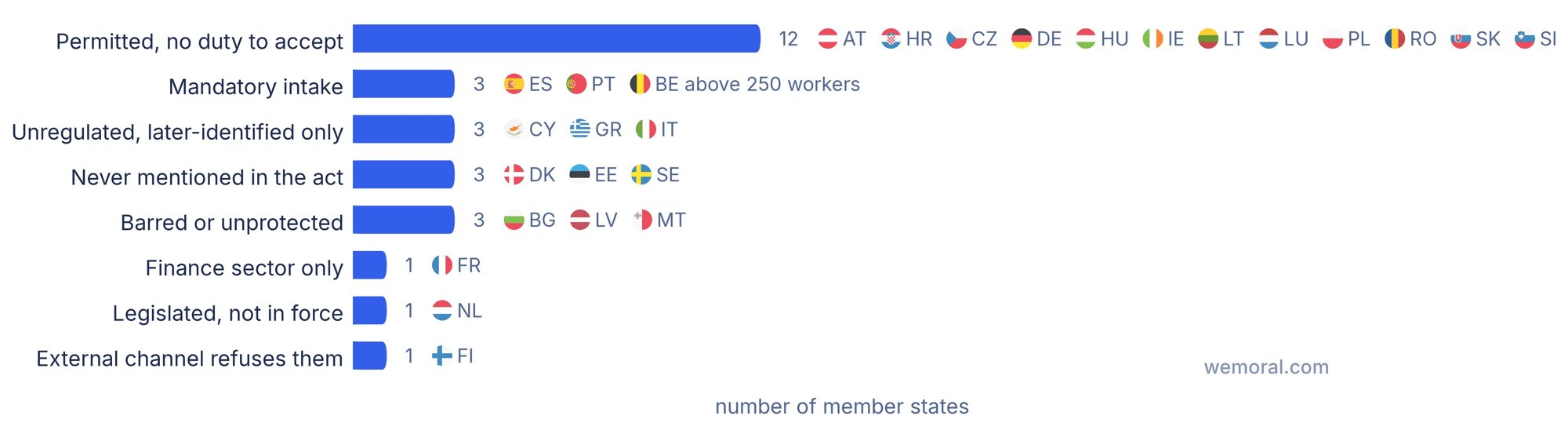
Source: WeMoral, 2026 Report on Whistleblower Directive Transposition Across the EU, p. 15.
"3 of 27 member states force companies to accept anonymous reports; three others bar or exclude them."
WeMoral, 2026 Report on Whistleblower Directive Transposition Across the EU, p. 4
The table below puts every state in its camp. Each line says what the rule means for a reporter.
| Country | Stance on anonymous reports | What it means |
|---|---|---|
 Austria Austria | Permitted | No duty to accept |
 Belgium Belgium | Required over 250 staff | Private sector only, smaller firms exempt |
 Bulgaria Bulgaria | Barred | Name and signature required to open a case |
 Croatia Croatia | Permitted | No duty to accept |
 Cyprus Cyprus | Not regulated | Only the later-identified reporter is covered |
 Czechia Czechia | Permitted | Standard form still asks for a name |
 Denmark Denmark | Not addressed | The act never mentions it |
 Estonia Estonia | Not addressed | The act never mentions it |
 Finland Finland | Internal only | External authority refuses anonymous reports |
 France France | Required in finance only | Permitted elsewhere, no duty |
 Germany Germany | Permitted | Entity "should" act on them, no duty |
 Greece Greece | Not regulated | Only the later-identified reporter is covered |
 Hungary Hungary | Permitted | Investigation may be skipped if the reporter is unknown |
 Ireland Ireland | Permitted | Must publish the conditions if it accepts them |
 Italy Italy | Not regulated | Only the later-identified reporter is covered |
 Latvia Latvia | Barred | No anonymous route, pseudonymisation instead |
 Lithuania Lithuania | Permitted | No duty to accept |
 Luxembourg Luxembourg | Permitted | No duty to accept |
 Malta Malta | Unprotected | Anonymous reporters excluded from protection |
 Netherlands Netherlands | Legislated, not in force | The provision never commenced |
 Poland Poland | Permitted | No duty to accept |
 Portugal Portugal | Required | Internal and external, failure is an offence |
 Romania Romania | Permitted | No duty to accept |
 Slovakia Slovakia | Permitted | No duty to accept |
 Slovenia Slovenia | Permitted | Confidential person may decline the report |
 Spain Spain | Required | Internal and external channels |
 Sweden Sweden | Not addressed | The act never mentions it |
Source: WeMoral, 2026 Report on Whistleblower Directive Transposition Across the EU, p. 15.
Which countries require anonymous reporting?
Only three make it a duty. Spain and Portugal require anonymous intake in both the internal and the external channel. Portugal goes furthest. There, failing to provide the anonymous channel is a serious offence. Belgium sets the duty for private employers with more than 250 workers, and lets smaller ones off. For the detail, see the Spanish, Portuguese and Belgian whistleblower laws.
Which countries bar or exclude anonymous reports?
Three states close the route. Bulgaria will not open a case on an anonymous report and asks for a name and a signature on the form. Latvia has no anonymous route at all. Instead, it masks the reporter's identity in the file. Malta leaves anonymous reporters unprotected, but the reporting officer or the external Unit may still act on the report. Even in these three, a reporter who files anonymously and is named later keeps the Directive's protection. The Bulgarian, Latvian and Maltese whistleblower laws set out each position.
For a group that runs one channel across borders, these three states set the hard edge. A shared form that takes anonymous reports works in Spain and Portugal. In Bulgaria the same form has to collect a name before a case can start. Building one process that fits a mandate state and a bar state at once is the hard part.
| Country | What the statute says |
|---|---|
| Spain | Anonymous reports must be accepted in both the internal and external channel. |
| Portugal | Anonymous intake is compulsory in both channels, and failing to guarantee it is a serious administrative offence. |
| Belgium | Private-sector employers with more than 250 workers must accept anonymous reports, smaller ones are exempt. |
| Bulgaria | Anonymous reports cannot start a procedure, and the form requires a name and a signature. |
| Latvia | There is no anonymous route, the law uses forced pseudonymisation of the reporter's data. |
| Malta | Anonymous reporters get no protection, though the reporting officer or the external Unit may still act on the report. |
Source: WeMoral, 2026 Report on Whistleblower Directive Transposition Across the EU, p. 15.
What "permitted but not required" means for anonymous reports
Twelve states sit in the largest camp, and permitted does not mean welcomed. Germany says a firm should act on an anonymous report, but has no duty to allow one. Ireland lets a company refuse anonymous reports. If it accepts them, it must publish the terms and run the full process. Czechia permits them, yet its own standard form still asks for a name and date of birth. Slovenia lets the confidential person turn the report down. Hungary lets the case be dropped when the reporter cannot be named. So a worker in a permit state can usually file anonymously. Whether anything happens next depends on the employer.
What anonymous-reporting rules mean for a cross-border channel
A company must follow the law of every country it works in, so the strictest rule wins. If your footprint includes Spain or Portugal, your channel has to accept anonymous reports. If it includes Bulgaria, the same channel has to take a named report to open a case there. The simplest answer is one channel. Accept anonymous reports everywhere, and treat the few states that need a name as a local step. That beats running 27 separate designs. Picking that channel is a practical choice. We compare the options in the best whistleblowing channel and whistleblowing software versus email.
How 27 member states transposed Directive 2019/1937, and where their laws still disagree on fines, anonymity, deadlines and protection.
Get full report for free nowMake anonymity the default
Anonymous intake is not a box to tick in three countries and ignore in the rest. It is the feature that decides whether a worker trusts the channel enough to use it. A report that never arrives protects no one. That is why WeMoral takes anonymous reports by default. It keeps the option to collect a name where a country asks for one. The same channel then works from Lisbon to Sofia. Set anonymity as the default, add the local exceptions, and you are done. The full picture sits in the 2026 transposition report. It runs country by country, with the deadlines, retention rules and penalties next to the anonymity rules. Read your countries' rows before you finalise the form.

Compliance specialist focused on policy roll-out and internal information flow. Writes on EU rule-making, landmark cases, and implementing reporting software.