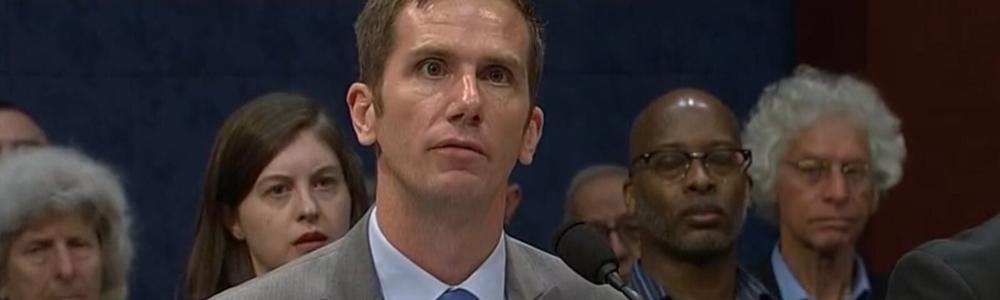
Dylan Borland says reporting a UAP cost him his career
Dylan Borland is a US Air Force veteran who says one report ended his career. On 9 September 2025 he told a House panel that he saw a triangular craft over Langley Air Force Base in 2012. He says the government then spent more than a decade pushing him out of intelligence work. He is now unemployed.
Key Takeaways
- Dylan Borland is a former Air Force intelligence analyst who reported a UAP sighting in 2012.
- He told Congress the craft was a silent triangle that hovered about 100 feet above him.
- He says he was blocked from clearances and blacklisted from intelligence work for over ten years.
- He spoke at a September 2025 hearing on UAP transparency and protecting the people who report them.
- Four other witnesses, plus a new military drone video, were part of the same hearing.
Who is Dylan Borland?
Dylan Borland is a former US Air Force geospatial intelligence analyst. He served on active duty from 2010 to 2013 in a "1N1" imagery role. After the Air Force he kept working in the field as a senior analyst for the contractors BAE Systems and Intrepid Solutions. He held high-level clearances and worked on classified programs. He says that access later put him near information about a legacy UAP recovery effort.
For more than ten years he stayed quiet in public. The September 2025 hearing was his first time on the record. Unlike the insiders who came before him, he never ran a Pentagon office or wrote a bestseller. He is a working analyst who says he saw something, reported it, and lost his career for it.
The 2012 Langley sighting
Borland's account centers on one night in 2012 at Langley Air Force Base in Virginia. He says he first saw a white light stop in mid-air and thought it was a weather balloon. As the light moved toward him, he says, a solid shape formed around it. He describes a silent triangle, one to two stories thick, with a light on each corner and a larger light in the center.
"I saw a white light pop up and stop about 100 feet in the air. The light then flies across the base, across the flight line, and as it flies to me, a triangle manifests around the light."
Dylan Borland, testimony to the House Oversight Task Force, 9 September 2025
He says the surface of the craft did not look solid. He describes a glowing skin that seemed to flow. His phone, he told the panel, grew hot and died. He says he felt static across his body and smelled something like the air after a lightning storm. Then, he says, the craft left in an instant.
"There was this gold, lava plasma, some type of fluid going over and around the craft. The center light flashes two to three times, no sound. Immediately shoots up to commercial jet level."
Dylan Borland, testimony to the House Oversight Task Force, 9 September 2025
None of this can be checked by an outside reader. There is no public video of the Langley craft. What we have is sworn testimony, given in a hearing room, under the rules of Congress. That is the same kind of evidence that earlier UAP witnesses brought.
A decade of retaliation
The heart of Borland's story is not the craft. It is what he says happened after he reported it. He told lawmakers that his career was broken on purpose. He says agencies blocked and delayed his clearances, then took away his ability to work in the field at all. He says the pattern ran for more than ten years.
In his words, "my professional career was deliberately obstructed and I have endured sustained reprisals from government agencies for over a decade." He described "blocking, delaying, and ultimately removing my ability to be employed within the IC," the intelligence community. He says he is still shut out today. "I and many other whistleblowers have no job prospects, no foreseeable professional future," he told the room.
This is the part that ties his case to the hearing's title. The panel was not just about strange lights. It was about whether the people who report them have any protection when they do. Borland says he had none.
 WeMoral - whistleblowing software
An anonymous, encrypted whistleblower reporting channel for your employees, suppliers and customers, with case management, the 7-day and 3-month deadlines, and audit logs. Be compliant with the whistleblowing laws that apply to you, in minutes.
Who else testified on 9 September 2025
The hearing was called "Restoring Public Trust Through UAP Transparency and Whistleblower Protection." It was run by the House Oversight Committee's Task Force on the Declassification of Federal Secrets. Rep. Anna Paulina Luna chaired it. Borland was one of five witnesses. You can watch the full session on C-SPAN.
| Witness | Role | What they brought |
|---|---|---|
| Jeffrey Nuccetelli | US Air Force veteran | Sightings near Vandenberg in the mid-2000s, which he called "flying buildings" |
| Alexandro Wiggins | Active-duty US Navy senior chief | A 2023 sea encounter with a "Tic Tac" object that rose from the water |
| George Knapp | KLAS-TV investigative reporter | Decades of UAP reporting and the case that much evidence is already public |
| Dylan Borland | US Air Force veteran | The 2012 Langley triangle and over a decade of reprisals |
| Joe Spielberger | POGO senior policy counsel | The legal case for real whistleblower protection |
Jeffrey Nuccetelli is an Air Force veteran with about sixteen years of service. He spoke about objects seen near a nuclear-weapons site. "What we saw changed our lives," he said. Alexandro Wiggins was the first active-duty Navy chief to testify in public on this topic. He described a 2023 case where his crew tracked a self-lit object that came out of the sea. "What I observed and what our crew recorded was not consistent with conventional aircraft or drones," he said. He asked for safe reporting channels so sailors do not fear for their careers.
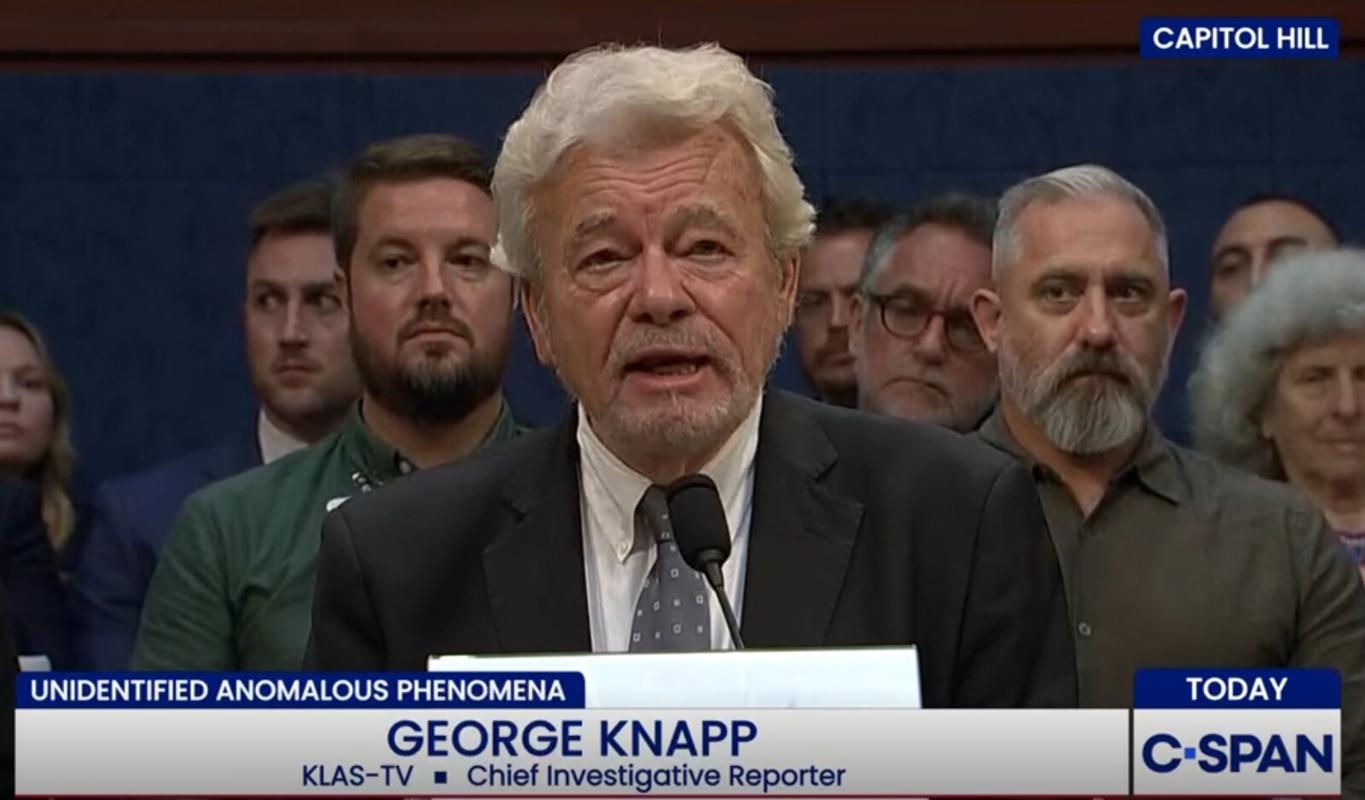
Investigative journalist George Knapp (center) testifying, with Jeremy Corbell (right) and Matthew Brown (left). ©C-SPAN
George Knapp is a veteran reporter from KLAS-TV in Las Vegas who has covered UAP for decades, ever since he broke Bob Lazar's 1989 Area 51 claims. His point was blunt. The evidence, he argued, is no longer a secret. Joe Spielberger, senior policy counsel at the Project On Government Oversight, was the minority witness. He did not bring a sighting. He brought the legal frame, and he made the case that people who report wrongdoing protect the public when they do.
One man in the room did not testify but matters to the story. Matthew Brown, seen at the left of the photo above, is a former national-security official who worked at the Office of the Secretary of Defense and the State Department. He wrote a roughly 12-page brief for Congress on an alleged secret program he called "Immaculate Constellation," said to collect UAP imagery from classified servers. Journalist Michael Shellenberger first reported it, and Rep. Nancy Mace entered the brief into the record at the November 2024 UAP hearing. Brown named himself as the author in April 2025. He says he raised the alarm up his chain, was told to delete the files, sought whistleblower protection, and got nowhere. His path looks a lot like Borland's.
The drone video Burlison released
The hearing produced one piece of new visual evidence. Rep. Eric Burlison played footage that he said came from a US military MQ-9 Reaper drone. He said it showed the aircraft firing a Hellfire missile at a small round object off the coast of Yemen in October 2024. The object, he said, appeared to be hit but was not destroyed.
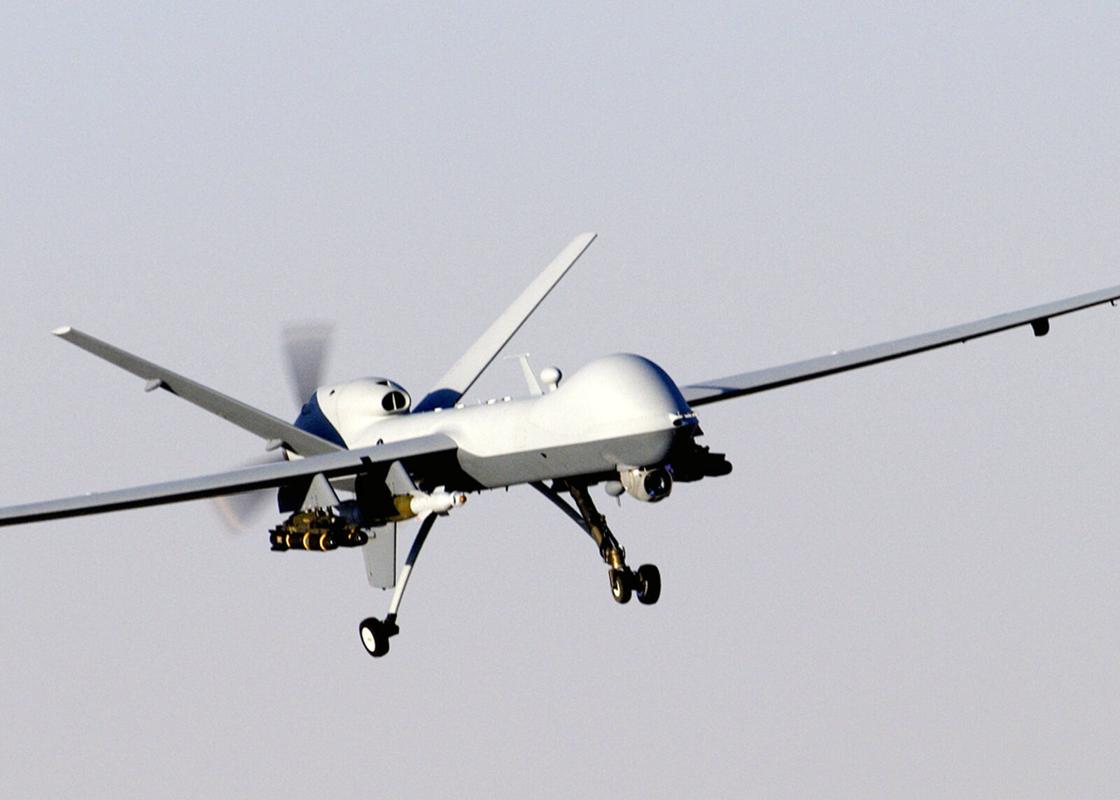
A US Air Force MQ-9 Reaper, the drone type that filmed the object off Yemen. Photo: U.S. Air Force (public domain).
Burlison used the clip to press a point. If footage like this exists, he asked, why is the public blocked from it? The Pentagon's own desk for these reports, the All-domain Anomaly Resolution Office (AARO), has stood by a careful line. The office, set up in 2022, says it has no verifiable evidence of extraterrestrial activity or technology. A still from the footage he released is below.
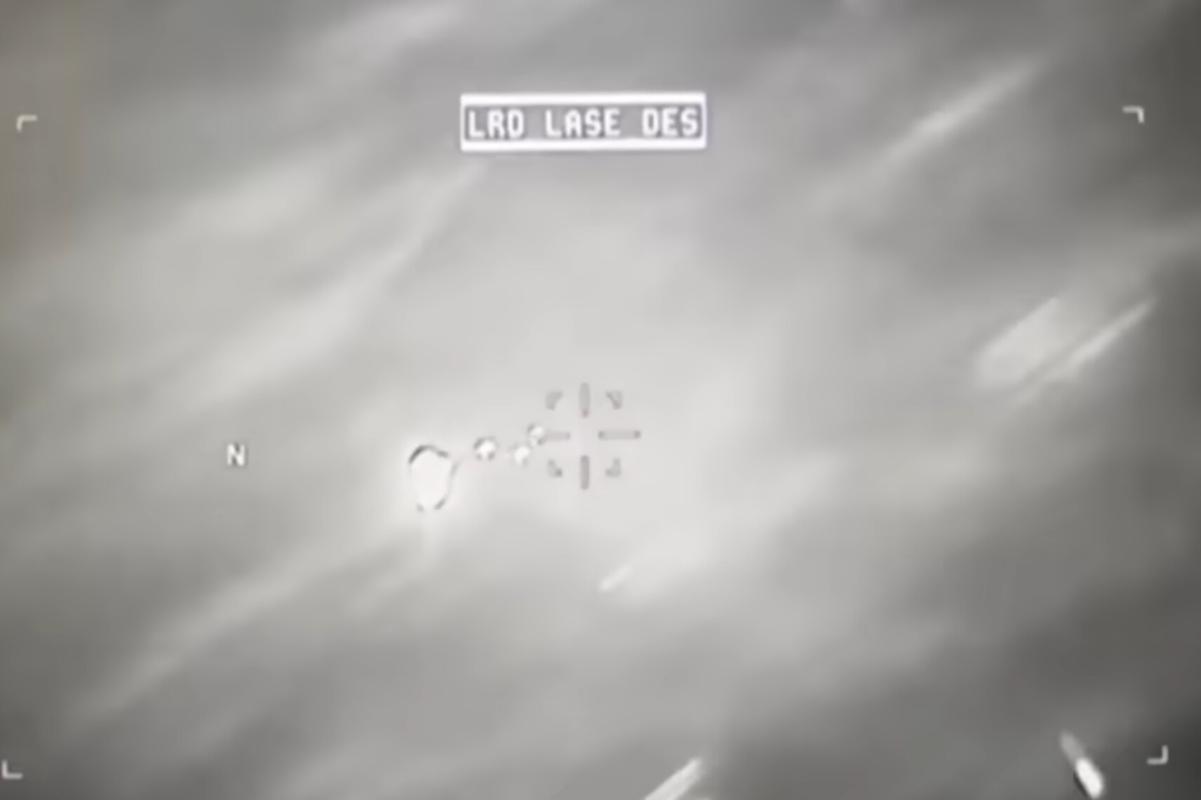
A still from the MQ-9 Reaper footage of an object off the coast of Yemen, October 2024, released by Rep. Eric Burlison at the hearing. ©C-SPAN
Where Borland's case fits, and why the law still has a gap
Borland is the third UAP witness in a short line of high-profile hearings. The other two are better known. In 2023, former intelligence officer David Grusch told Congress he had been briefed on a hidden craft-retrieval program, though he had not seen the material himself. In 2024, former Pentagon official Lue Elizondo testified that the United States runs a UAP program with no real oversight. Both men are insiders who describe programs.
Borland is a different kind of witness. He is not describing a program he heard about in a briefing. He says he saw a craft himself, and he says he felt the punishment for reporting it himself. That is the thread that ties all three men together. The cost of speaking up landed on each of them, not on the system they tried to warn.
And the legal gap is real. Standard federal whistleblower law does not clearly cover people who report UAP-linked programs or funding. That leaves the very people most likely to know something with no safe channel and no shield. A proposed UAP Whistleblower Protection Act, pushed by Rep. Tim Burchett and Rep. Luna, would extend cover to military staff, intelligence officers, and contractors who come forward. Until something like it passes, the choice stays harsh. Stay silent, or risk everything Borland says he lost.
Dylan Borland: frequently asked questions
Who is Dylan Borland?
He is a US Air Force veteran and former geospatial intelligence analyst. He served on active duty from 2010 to 2013 and later worked as a contractor in the field. He testified in public for the first time in September 2025.
What did Dylan Borland say he saw?
He says he saw a silent triangular craft at Langley Air Force Base in 2012. He describes it hovering about 100 feet up, with a glowing, fluid-like skin, before it shot away at high speed. He says his phone died during the encounter.
What retaliation does Borland describe?
He says agencies blocked and delayed his security clearances and then removed his ability to work in intelligence. He says the reprisals ran for more than a decade and that he is now unemployed with no clear future in the field.
How is Borland different from David Grusch and Lue Elizondo?
Grusch and Elizondo are insiders who told Congress about alleged secret programs. Borland is a firsthand witness who says he saw a craft and was punished for reporting it. His case is more about reprisal than about a program.
Borland walked into that hearing room with no clearance, no job in his field, and no law clearly built to protect him. He walked out the same way. Whether his triangle was real is a question the public record cannot yet answer. Whether a person who reports one should lose a career over it is a question Congress can. That is the one Borland left on the table.
Researcher and data analyst in whistleblowing. Tells the stories of famous whistleblowers and the history behind their fight for accountability.