Bob Lazar said he reverse engineered alien craft at Area 51
Bob Lazar says he once worked on alien spacecraft. He claims he did the work at a secret base called S-4, tucked into the desert south of Area 51 in Nevada. He went public in 1989 on a Las Vegas TV station. In all the years since, no one has been able to prove a single part of his story.
That is what makes the Lazar case so strange. Most famous disclosures leave a paper trail. His left almost nothing an outsider can check. Yet his account did not fade. It launched the modern Area 51 myth and still draws big crowds online. So the question is not just whether he told the truth. It is why a story with so little proof has lasted so long.
Key Takeaways
- Bob Lazar claims he reverse engineered an alien craft at a secret site near Area 51.
- He first told the story in 1989 to TV reporter George Knapp, using a fake name.
- He said the craft ran on element 115, a metal that science had not yet made.
- Scientists later made element 115 and named it moscovium, but it falls apart in under a second.
- No school, employer, or document has ever backed up his account.
Who is Bob Lazar?
Bob Lazar is an American man who says he is a physicist. He claims that in 1988 and 1989 he helped the US government study captured alien craft. The work, he says, took place at S-4, a hidden base south of Area 51. He has no degree anyone can verify and no employer who will confirm the job. Today he sells scientific gear for a living.
 WeMoral - whistleblowing software
An anonymous, encrypted whistleblower reporting channel for your employees, suppliers and customers, with case management, the 7-day and 3-month deadlines, and audit logs. Be compliant with the whistleblowing laws that apply to you, in minutes.
He was born in 1959 and grew up around New York. He later moved to Los Alamos and then to Las Vegas. For decades he has run a mail-order company called United Nuclear Scientific, which sells lab supplies, magnets, and chemistry kits. He rarely speaks to the press. He says he hates the fame and never wanted it. Critics say the low profile is part of the act.
For years he was a fringe name. Then two things pulled him back into view. In 2018, filmmaker Jeremy Corbell put out a documentary about him, Bob Lazar: Area 51 & Flying Saucers. In 2019, Lazar sat down for a long talk on the most popular podcast in the world. A new generation heard the story for the first time, and the old debate started over again.
The 1989 interview that started it
The whole story began with one reporter. In May 1989, investigative journalist George Knapp put Lazar on the air at Las Vegas station KLAS. Lazar hid his face and used the fake name "Dennis". That winter he came back on camera under his own name. The interviews turned a local news segment into a national sensation.
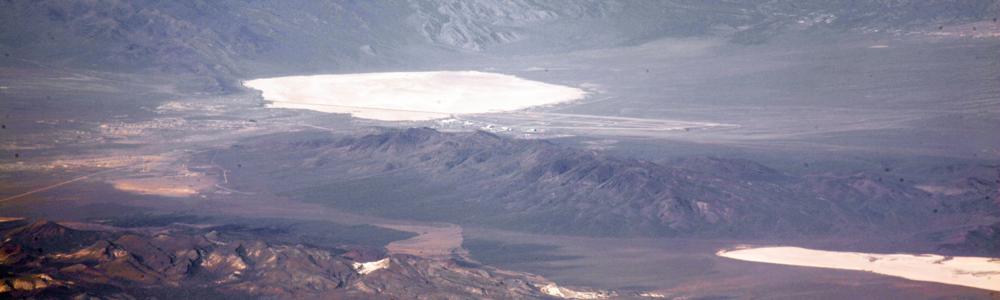
Lazar's account was vivid. He said S-4 sat near Papoose Lake, just south of the main Area 51 base. He described nine flying discs parked in hangars cut into the base of a mountain. The hangar doors, he said, were sloped and painted to blend into the desert. His job was to study the power source of one craft and work out how it flew. He said he saw a chair built for a small body and a craft that had no bolts or welds.
"This stuff came from somewhere else. I know it is hard to believe, but it is there and I saw it. I know what the current state-of-the-art is in physics and it can't be done."
Bob Lazar, KLAS-TV interview with George Knapp, November 1989
Knapp did not just take Lazar at his word. His team spent years checking the parts they could. They found people who placed Lazar in the right circles, and they tracked the strange lights Lazar said would fly on test nights. You can read the station's own look back at how the saga began. But the core of the tale, the discs and the alien tech, was never something an outsider could confirm.
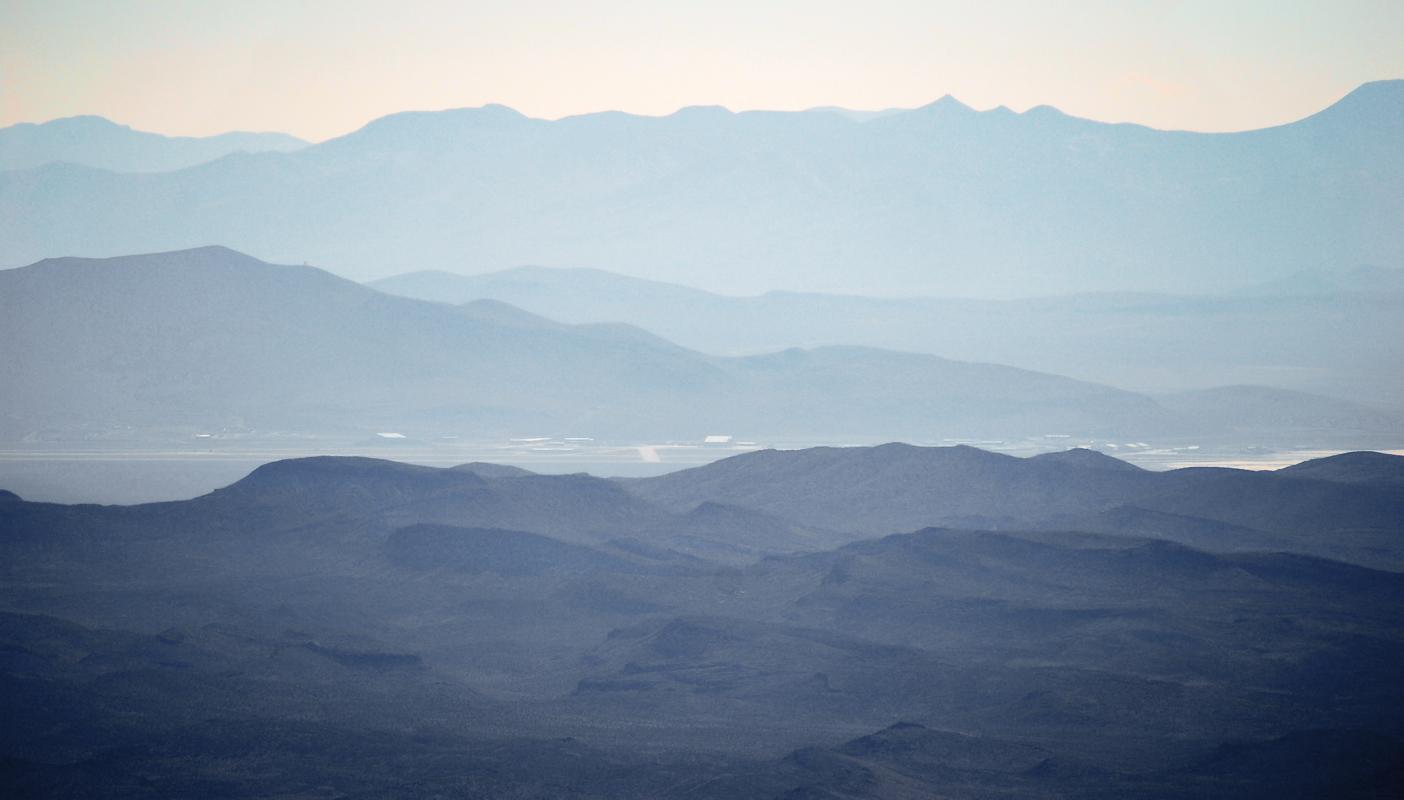
Area 51 seen from Tikaboo Peak, the nearest legal public viewpoint. Photo by Geckow (public domain).
What Lazar said about element 115
The most testable claim Lazar made was about fuel. He said the craft ran on a heavy metal he called element 115. He said a stable form of it bent gravity and drove the saucer. There was one problem at the time. Element 115 did not exist. No lab had ever made it, and it sat as a blank box on the periodic table.
"The power source is an anti-matter reactor. They run gravity amplifiers. There is actually two parts to the drive mechanism. It's a bizarre technology."
Bob Lazar, KLAS-TV interview with George Knapp, November 1989
Then science caught up, sort of. In 2003, a Russian and American team in Dubna made the first atoms of element 115. In 2016 it was officially named moscovium by the global chemistry body. Fans of Lazar called this a hit. He had named the right number years before the rest of us.
But the detail kills the claim. Lazar said his element 115 was stable. The real moscovium is the opposite. Every form made so far breaks apart in well under a second. You could not build an engine from it, let alone a craft that crosses space. Believers answer that the right form just has not been made yet. That answer can never be proven wrong, which is exactly the trouble with it.
The credentials no one can confirm
For a physics story, the physics degree matters. Lazar says he holds degrees from MIT and Caltech. Both schools say they have no record of him. Reporters who searched class lists and alumni files came up empty. His claimed defense-industry employer, the contractor EG&G, also said it had nothing on file.
"The schools that I went to, the hospital that I was born at, past jobs, and nothing comes up with my name on it."
Bob Lazar, KLAS-TV interview with George Knapp, November 1989
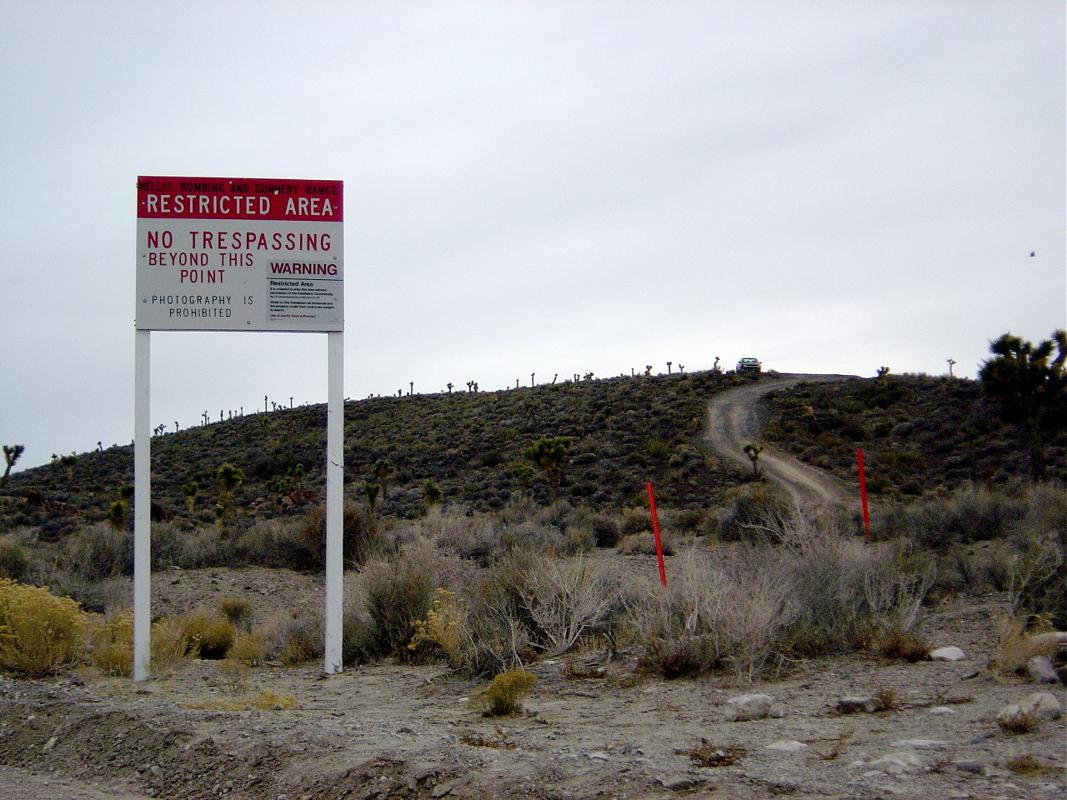
A warning sign at the edge of the Area 51 restricted zone. Photo by X51 ©X51 (CC BY-SA 3.0)
The one piece of paper he showed was a W-2 tax form. It listed pay of under one thousand dollars from a body he called the "Department of Naval Intelligence". No agency by that exact name exists. Even the form itself was picked apart by skeptics, who doubted it was real. So his single bit of hard proof raised more questions than it settled.
It is not all one way. Knapp's team turned up a 1982 Los Alamos phone book that listed Lazar among the lab staff. They also found a 1982 local news story about his jet-powered car that called him a physicist at the lab. So Lazar clearly had some real link to Los Alamos. What no one can show is the leap from a lab job to a hangar full of saucers.
Why the 2017 FBI raid was not about aliens
In 2017, the FBI and local police raided United Nuclear Scientific, Lazar's company. To him and his fans, the timing felt loaded. It happened while Corbell was filming the documentary. Lazar suggested the agents had come to grab his sample of element 115. It looked, to believers, like the cover-up reaching back in.
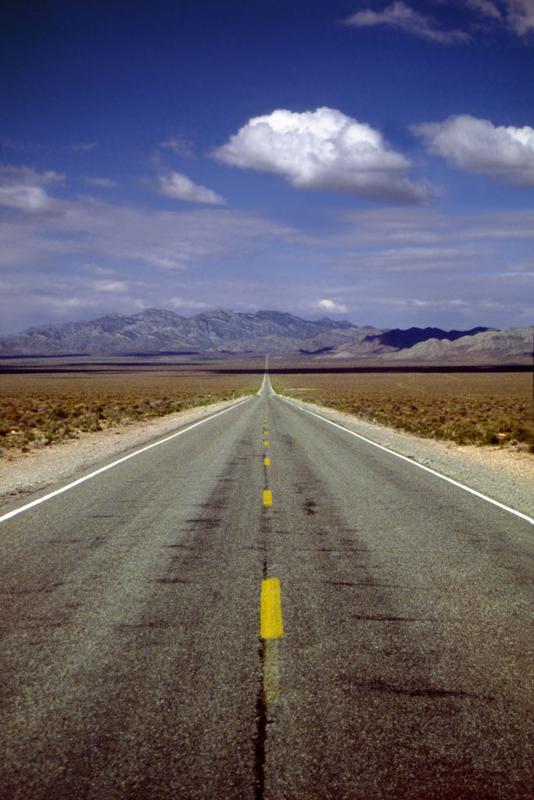
Nevada State Route 375, the "Extraterrestrial Highway", named for its link to Area 51. Photo by Rod Jones ©Rod Jones (CC BY 2.0)
The records tell a flatter story. The raid was part of a murder case in Michigan that involved thallium poisoning. Police wanted to know if Lazar's shop had sold the poison to a suspect. Lazar was not named as a suspect himself. The FBI had been working the case since 2016, long before the film. So the raid had nothing to do with saucers or secret fuel. It was a supplier check in a poisoning case that happened to land on a famous name.
The 2026 documentary that brought him back
Lazar returned to the spotlight with a new film. S4: The Bob Lazar Story, directed by Luigi Vendittelli, landed on Amazon Prime Video on 3 April 2026. Lazar narrates it himself. The crew built full-scale recreations of the S-4 hangars and the disc he says he studied.
The release came with a media run. The same day, Lazar went back on The Joe Rogan Experience (episode 2479) with Vendittelli to talk through the film. Lazar's interview with Jesse Michels on the American Alchemy channel ran long, too. It was his biggest public push since the 2019 Netflix film.
A slicker retelling is not new proof. The film stages his story with sets and models, but it adds no craft, no document, and no record anyone outside can test. The old gaps are still open. Los Alamos paperwork still lists him as a technician, not a senior physicist, and MIT and Caltech still have no record of his degrees. The film has reached a bigger audience than ever, yet it brings the story no closer to proof.
What makes a whistleblower credible
A claim like Lazar's lives or dies on what can be checked. Strong whistleblower cases tend to leave a trail. There are papers, named witnesses, physical proof, or a formal complaint on the record. Lazar's case has almost none of that. That gap is why his story sits outside the cases courts and regulators ever act on.
It helps to spell out what a sturdy disclosure usually carries:
- Documents a third party can pull and read.
- Named witnesses who back the account on the record.
- Physical proof that survives an independent test.
- A formal channel, such as a report to a regulator or an oversight body.
- Expert review that holds up the technical claims.
The UFO field has produced sharper test cases since Lazar. Two former officials, David Grusch and Luis Elizondo, made big claims of their own. The key difference is the setting. Both men told their stories to Congress, under oath, with their names and careers on the line. Lazar never did. The table below lays the three side by side.
| Claimant | Core claim | Evidence offered | Told it under oath? |
|---|---|---|---|
| Bob Lazar (1989) | Reverse engineered a saucer at S-4 | A disputed W-2; no craft, no documents | No, on TV |
| David Grusch (2023) | US runs a craft-retrieval program | Named 40 witnesses; saw no craft himself | Yes, to Congress |
| Luis Elizondo (2024) | US holds non-human craft | Three cleared Navy videos; a memoir | Yes, to Congress |
None of those three has handed over a piece of a craft. But Grusch and Elizondo put their claims into a record that can be tested, challenged, and acted on by lawmakers. Air Force veteran Dylan Borland took the same formal route, telling a 2025 hearing he was blacklisted for years after reporting a UAP through official channels. Lazar gave the public a story and a single odd tax form. That is the line between a claim the system can chase and one it can only argue about.
Bob Lazar: frequently asked questions
Is Bob Lazar a whistleblower?
He calls himself one. He says he exposed a secret government program and was punished for it. But he never used a formal channel and never gave proof an outsider could test. So most people in the field treat him as a claimant, not a confirmed whistleblower. The label is part of what people argue about.
What is S-4?
S-4 is the name Lazar gave to a base he says sits near Papoose Lake, south of Area 51. He claims nine alien craft were stored there in hidden hangars. No map, photo, or document has ever confirmed that such a facility holds what he described. Area 51 itself is real and is a US Air Force test site.
Is element 115 real, and what is it used for?
Element 115 is real, but not the way Lazar described it, and it has no practical use. Scientists first made it in 2003 and named it moscovium in 2016. Only a handful of atoms have ever existed, and each one decays in well under a second. That is far too few, and far too short-lived, for any use at all, let alone a spacecraft fuel. Lazar said his version was a stable metal that powered a craft, and no such form has ever been found.
Has Bob Lazar done a polygraph?
Yes. In 1989, George Knapp arranged several lie-detector tests for him. The first came back inconclusive. A second examiner ran four more and found no sign of deception, and a third agreed. But a fourth examiner disagreed, and suggested Lazar might be repeating information he had picked up from someone else. The examiners would not call it either way. A polygraph can hint that someone believes what they are saying. It cannot show where the knowledge came from.
Did Bob Lazar really work at Area 51?
No one has proven it. Records tie him to the Los Alamos lab in the early 1980s. But MIT, Caltech, and his claimed defense employer all say they have no record of the degrees and jobs he describes. The secret part of his story has never been backed up.
What is the 2026 Bob Lazar documentary, and where can you watch it?
There are two major documentary films about him. The most recent is S4: The Bob Lazar Story (2026), which leans on detailed 3D CGI to recreate the S-4 facility and the craft from Lazar's descriptions. It streams on Amazon Prime Video. The first well-known one is Bob Lazar: Area 51 & Flying Saucers (2018), directed by Jeremy Corbell, later carried by Netflix.
Lazar's story has a rare quality. It cannot be proven, and it cannot be killed. There is no craft to show and no document to seal it shut, so the argument never ends. A real reporting system runs on the opposite of that. It runs on names, dates, and files someone can pull and check. Lazar handed the world a tale with none of those, and the world is still passing it around the campfire, no closer to the truth than the night it first aired.

Researcher and data analyst in whistleblowing. Tells the stories of famous whistleblowers and the history behind their fight for accountability.