
New Corporate Goals and Challenges
Setting new corporate goals for the year ahead is a familiar reflex. Send the deck around, run the all-hands, hand the targets to managers, and watch the cascade. The unstated assumption underneath is that the people meant to hit those goals are engaged enough to carry them. That assumption no longer holds. The engagement floor under most goal-setting cycles has dropped, and the ground keeps moving.

The engagement floor has dropped
Gallup's State of the Global Workplace 2026 puts global employee engagement at 20%, the lowest reading since 2020, and pegs the cost at roughly $10 trillion in lost productivity, around 9% of world GDP. The deeper finding sits one layer up: manager engagement has slid from 31% in 2022 to 22% in 2025, and managers are dragging the rest of the workforce down with them.
"managers used to enjoy an 'engagement premium' at work, but they are increasingly only as engaged as those they lead."
State of the Global Workplace 2026 @ Gallup
The European picture is starker. Engagement on the continent sits at 12%, the lowest of any global region, with France at 8% and Poland at 7%. A leadership team writing fresh goals into employee sentiment like that is throwing them at a wall that no longer absorbs anything. The starting point for any goal cycle should be how employees actually feel, before the targets land, not after they stall.
Goals collide with the office-mandate fight
The 2024 and 2025 wave of return-to-office mandates has made the gap visible. Amazon required corporate staff back five days a week from January 2, 2025. In a Blind survey of 2,585 employees, 91% reported being dissatisfied, 73% said they were considering leaving, and 87% predicted their productivity would fall. JPMorgan Chase followed with a five-day mandate for its 317,000 employees in March 2025. Fortune's reporting from inside the rollout described desk shortages, broken Wi-Fi, and colleagues working through illness; one employee told the magazine, "There definitely aren't enough desks for everyone so people have to hope others are taking PTO that day to get a seat" (Fortune).
"Can't learn working from your basement."
Jamie Dimon, JPMorgan Chase CEO @ HR Grapevine
Companies imposing strict RTO see roughly 14% higher turnover and take 23% longer to fill open roles. New goals layered on top of that friction don't land; they dissolve. The trust dynamics of leading distributed teams haven't gone away just because the mandate said so.
Chaos is not a goal-setting environment
Microsoft's Work Trend Index 2025 found that 48% of employees and 52% of leaders describe their work as "chaotic and fragmented" (Microsoft). The data trail shows up in messages: an average of 58 chats arriving outside the 9-to-5, up 15% year over year, with late-evening meetings starting after 8 p.m. up 16%.
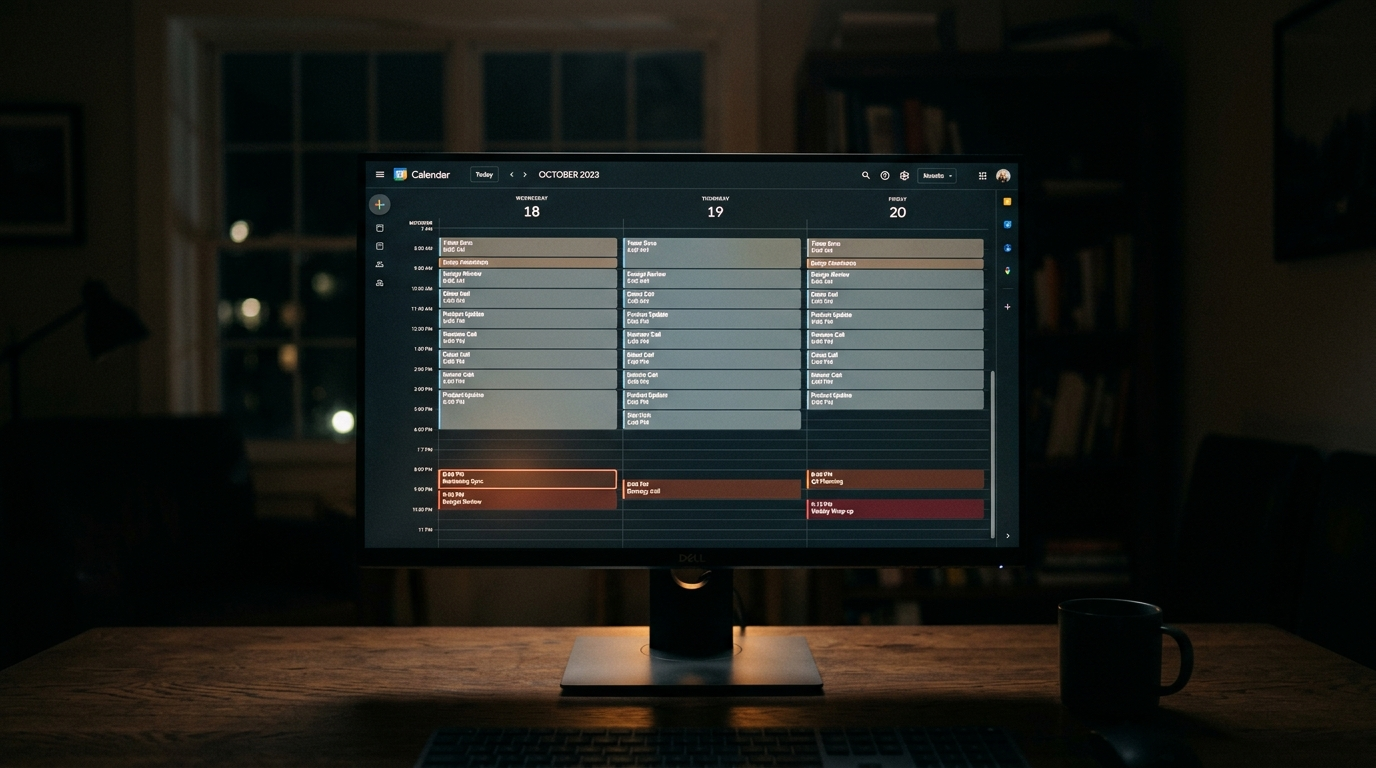
A goal-setting cycle dropped onto a workforce already running at that volume of after-hours noise doesn't add ambition; it adds another channel that someone is supposed to monitor while everything else keeps going. The harder version of "set new goals" is to subtract the existing ones that nobody is hitting and to cut the noise around the few that survive.
Speak-up safety is the prerequisite, not the perk
Ambitious goals work only when the people on the ground can push back on them, flag the parts that don't make sense, and surface the half-formed problems early. Without that loop, the cascade keeps cascading and the failures only become visible when a target slips badly enough to embarrass someone.
A goal-setting cycle without a safe channel for dissent fails silently. The usual framing is too passive: leaders should listen to employees without retaliating. A more useful framing is that the speak-up channel is part of the goal infrastructure, not a separate HR initiative. Operationally that means a real reporting route alongside the targets, which is one of the reasons companies still invest in whistleblower software when they get serious about the goal-setting they want to do.
What new goals should actually look like
Gallup's research keeps pointing back at managers. In best-practice organisations the manager engagement rate hits 79%, nearly four times the global average; the same study finds that employees are 8.7x more likely to view their work as transformed by AI when their manager actively supports the tooling, rather than handing it down as a directive.
The takeaway for a fresh goal cycle is fairly direct. Tie the ambition to the manager layer that has to carry it, and make the conversation genuinely two-way so that targets travel down while friction travels up and both arrive in the same room. Treat the speak-up channel as part of the goal infrastructure rather than an HR add-on. And, where you can, subtract more goals than you add.
When a goal cycle fails, ambition is rarely the reason. The cause usually sits earlier: the people meant to hit the targets weren't asked, weren't heard, and weren't protected when they pushed back. Setting the new corporate goals is the easy part. Building the conditions in which someone could plausibly reach them is the work.

Researcher, responsible for data analysis in the field of whistleblowing. Environmental engineer by education. Enthusiast of biographical novels.


