
Why whistleblowing software is better than email or telephone?
When we first wrote this article in 2022, most employers still treated whistleblowing channels as an afterthought. An email alias monitored by HR, a landline that rang on the compliance officer's desk, a vague promise of confidentiality in the staff handbook. That ambiguity is over. The EU Whistleblower Protection Directive is now transposed across all 27 Member States, and in March 2025 the Court of Justice fined five of them for foot-dragging, with Germany hit hardest at 34 million euros. Poland, the last holdout, brought its Whistleblower Protection Act into force on 25 September 2024, with criminal penalties of up to three years' imprisonment for anyone who retaliates against a reporter or leaks their identity. If you run a business with fifty or more employees anywhere in the EU, a reporting channel is no longer optional. It is a legal obligation, enforced by regulators with subpoena powers and, increasingly, by courts.
The question that follows is the one this article set out to answer in the first place. Can you meet the obligation with the tools you already have, a shared inbox and a phone number, or do you need dedicated whistleblowing software? Three years of real enforcement, data protection rulings, and independent benchmark data have made the answer clear. For most employers, a dedicated platform such as WeMoral is the only option that reliably passes a data protection impact assessment, stays outside the company's surveillance surface, and actually encourages employees to speak up.

What the law now requires
The EU Directive (2019/1937) sets a floor and national transpositions have raised it further. The floor is clear enough. Employers with at least fifty workers must provide an internal reporting channel that protects the confidentiality of the reporter, permits written and oral reports, acknowledges receipt within seven days, and delivers feedback within three months. Member States have layered their own requirements on top. France's CNIL issued an updated whistleblowing referential in July 2023 that requires a data protection impact assessment, strict access controls, and tight retention limits. Italy's Garante fined a hospital and its IT provider in 2022 after discovering that, even with a dedicated reporting app in place, firewall logs had captured connection metadata capable of unmasking reporters. No DPIA had been completed. The fine was a warning to every employer in Europe that a channel which leaks metadata is not really a channel at all.
Poland went further still. The Polish Whistleblower Protection Act requires a written internal policy, consultation with unions or employee representatives, a designated intake unit, a whistleblower register, and support for anonymous reports in regulated sectors including financial services and anti-money-laundering. Retaliation or identity disclosure carried out on the employer's behalf is a criminal offence, punishable by up to three years' imprisonment. Administrative fines apply even for procedural lapses. The cost of a compliant platform is rounding error compared to the exposure a Polish employer now carries from using an ad hoc channel.
Why email was never fit for purpose
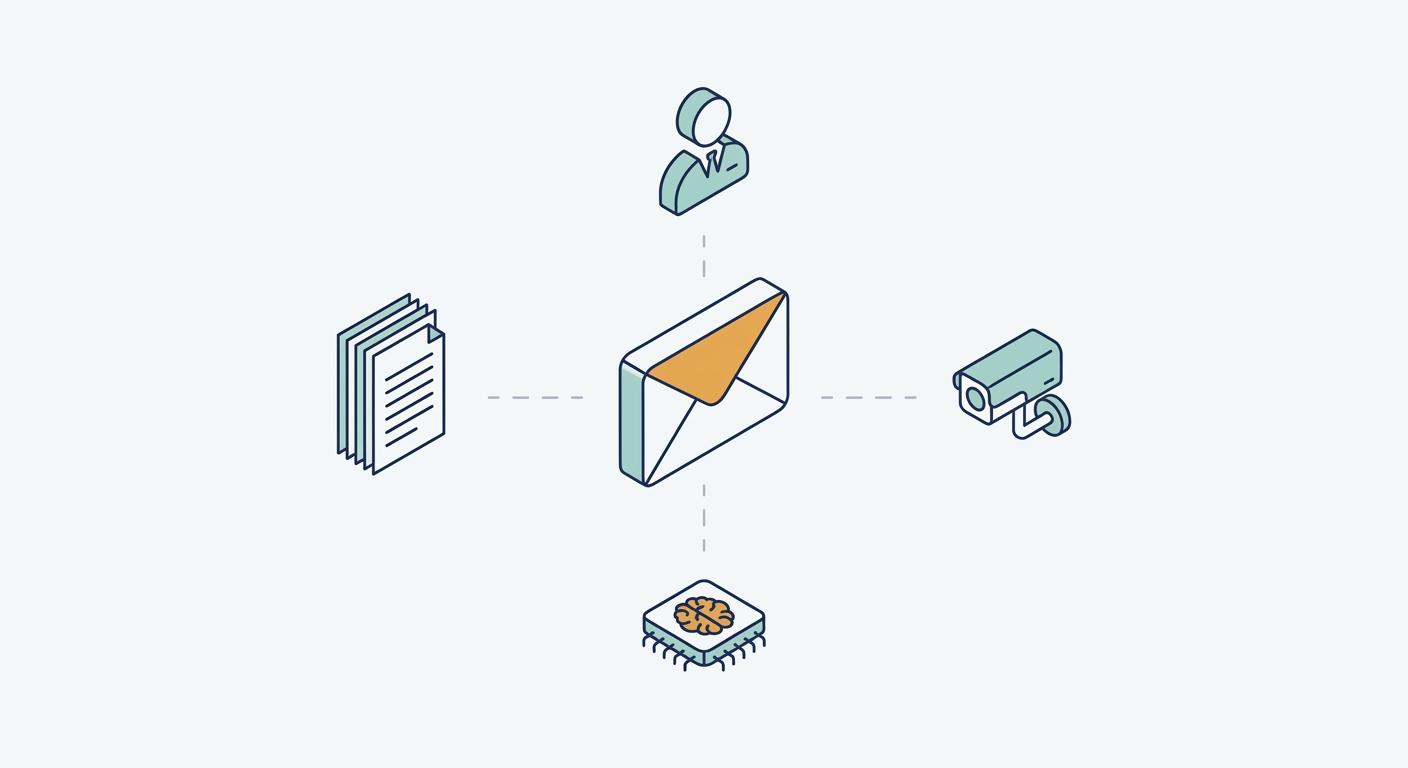
The original argument against email was simple. An email address is tied to an identity, a mail server logs every message, and backups keep copies long after the sender thinks the report is gone. In 2026 the argument has only got stronger, because the surveillance surface around corporate email has grown. Microsoft 365's Purview toolset gives administrators mailbox-read access, scans content for keywords, and scores employees on their outbound communications through Insider Risk Management. An Exchange transport rule keyed to the word "whistleblower" can flag every inbound report before it reaches the designated recipient. Admins with the right role can read the mailbox directly. None of this is exotic. It is the default posture of most mid-sized businesses.
The external threat is worse. The FBI's 2024 Internet Crime Report recorded 2.77 billion US dollars in losses from business email compromise alone, with HR and finance inboxes consistently among the most-attacked surfaces in any organisation. If an HR mailbox doubles as your whistleblower channel, it is on the receiving end of constant phishing and credential-stuffing attempts by actors who have no interest in ethics reports but will absolutely read every message they find. A single successful compromise exposes every report that sits in the archive.
Then there is the identification threat that barely existed in 2022. Large language models can now identify writing-style features with enough precision that a 500-word report is, in practice, biometric data. An adversary who can read a report and compare it against publicly available writing (Slack messages, LinkedIn posts, internal wiki edits) can deanonymise the reporter without ever seeing a name, a return address, or an IP log. This is called stylometry. It is not a theoretical risk. Off-the-shelf tools already do it well enough to matter in internal investigations. The only defence is to keep the report out of the surveilled surface in the first place.
Why phone hotlines are worse than they look
Telephone hotlines feel anonymous because they feel old-fashioned, but the 2020s have eroded that intuition. The FCC's STIR/SHAKEN framework, mandated by the TRACED Act and deployed across every major US carrier, attaches a cryptographically signed identity to every call placed over an IP network. A whistleblower calling from a personal mobile with caller ID blocked is still, from the carrier's perspective, fully identifiable. Equivalent authentication is rolling out across European networks. The idea that dialling *67 before the number hides a caller died years ago; the technology just caught up with the paperwork.
Independent benchmark data confirms that employees have figured this out. NAVEX's 2025 report, covering 2.15 million reports from around 4,000 organisations and 70 million employees, produced two findings that should settle any remaining debate. First, web-based intake has, for the first time, overtaken the telephone hotline as the most common reporting channel. Second, reports made through a web channel were anonymous 72% of the time, compared to 53% for phone, and reports made anonymously through a web channel were substantiated at 39% versus 33% for phone. Anonymous digital reports are both more frequent and, once investigated, more likely to turn out to be true. Employees trust the channel, and because they trust it, they bring forward the reports that matter.
Plain email fails the data protection test on its own terms
Suppose none of the above convinced you. The data protection regime will. Since the CNIL's 2023 guidance, any whistleblowing channel in France (and by practical extension across the EU) must be able to demonstrate a completed DPIA, a defined retention policy, access controls documented role by role, and a legal basis for processing that holds up to regulatory inspection. Plain email fails every one of these tests. It has no per-report access control, no retention schedule that can be enforced because backup tapes outlive the policy, no audit trail distinct from the rest of the inbox, and no practical way to satisfy the reporter's right to information about how their data is handled. A regulator asked to review such a channel will find it non-conforming within minutes. The Italian Garante case is the precedent. Dedicated software is necessary, and it must be configured correctly.
This is where the gap between a SaaS platform designed around these obligations and a tool retrofitted from a generic inbox shows up. WeMoral was built for the Directive. Reports are end-to-end encrypted, stored with per-case access control, logged without connection metadata that could identify the reporter, and retained on a schedule that matches the legal maximum rather than whatever the underlying object storage happens to keep. A DPIA stops being a project and becomes a one-page document, because the platform's own configuration already answers most of its questions.
The human stakes are not abstract
Compliance language makes all of this feel remote. 2024 was a reminder that reporter safety is not a checkbox. John Barnett, a former Boeing quality manager, was found dead in a Charleston parking lot on 9 March 2024, during a deposition in his retaliation suit against the company. His family filed a wrongful-death action in March 2025 alleging that years of harassment had caused the PTSD and depression that drove him to suicide, and the case settled that May. Eight weeks after Barnett's death, Joshua Dean, a 45-year-old quality auditor at Boeing supplier Spirit AeroSystems, died of a sudden infection after being fired for flagging mis-drilled holes on a 737 Max pressure bulkhead. Two whistleblowers in the same supply chain, gone within two months. No reporting software would have saved either man from the retaliation machinery that came for him, but both cases underline why the first, non-negotiable job of a channel is to keep the reporter's identity out of the hands of the people being reported on. A channel built for the purpose is the only class of tool that can.
What a fit-for-purpose channel actually looks like
The international benchmark for running a whistleblowing system is ISO 37002, published in July 2021 as guidance for organisations of every size. It is not a certification standard, but EU regulators increasingly cite it as the reasonable-measures reference. The standard describes four tasks: receiving reports, assessing them, addressing them, and concluding the matter, all under a framework of trust, impartiality, protection, and confidentiality. A channel that earns employee trust has, at a minimum, four properties.
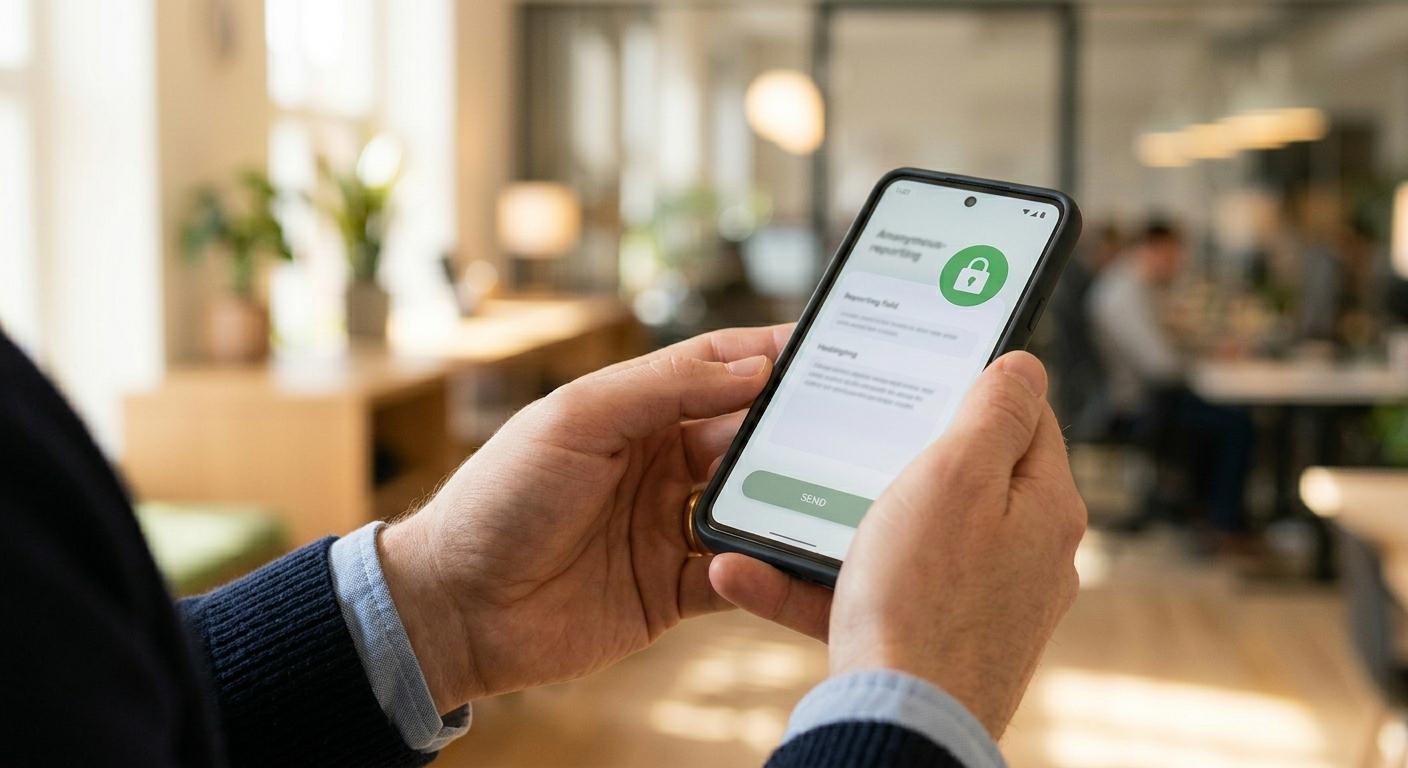
Anonymity is the default, with two-way messaging so an investigator can ask the reporter for clarification without ever learning who they are. The encryption is end-to-end, with keys held outside the employer's normal IT surface so a compromised domain admin cannot pivot into the whistleblowing store. The audit trail is DPIA-ready, recording what was done with each report but excluding the metadata (IP addresses, device fingerprints, firewall logs) that would identify the reporter. And the experience is simple enough that an employee who has never filed a report in their life can complete one from a mobile phone in under five minutes. WeMoral was engineered against exactly this list. It is not the only platform on the market, but it is the one that treats every item on the list as a hard requirement rather than a roadmap promise.
The 2026 question is no longer whether, but how well
Three years on from the original version of this article, the debate has moved. No serious compliance function is still asking whether to replace its ethics hotline inbox with a dedicated tool. The questions now are whether the tool they chose actually meets the Directive, passes a DPIA, resists metadata leakage, and invites the reports that would otherwise never come. If you are a Polish employer under the September 2024 Act, or a mid-sized business anywhere in the EU watching CJEU fines accumulate against your government for non-transposition, those are not rhetorical questions.
A well-written whistleblowing policy is a start, but the policy is only as strong as the channel that implements it. Pick a platform that was designed for the regulation you actually have to comply with, that treats anonymity as an engineering problem rather than a marketing claim, and that has been audited by the people who will audit you. WeMoral was built for exactly that job. For the employers who still ask whether dedicated software is really worth it over an ethics inbox, the answer in 2026 is the same as it was in 2022, only with considerably more evidence behind it. Yes, it is worth it, and the cost of getting it wrong has risen sharply.

Researcher, responsible for data analysis in the field of whistleblowing. Environmental engineer by education. Enthusiast of biographical novels.


