How Sherron Watkins exposed Enron's downfall
The Enron scandal is one of the worst corporate fraud cases ever. It pushed a respected energy company into bankruptcy. The crash wiped out about 20,000 jobs. It also wiped out billions of dollars in retirement savings. One person inside the company saw the truth most clearly. Sherron Watkins was a vice president there. She wrote a private memo to the CEO. She warned that Enron was about to "implode in a wave of accounting scandals." The case is back in the news more than two decades later. A parody relaunch of the Enron brand made headlines at the end of 2024. In February 2024 the U.S. Supreme Court rewrote part of the whistleblower rules built on the scandal. Every big fraud since Enron gets compared to it, from Theranos to FTX to the fake-compliance startup Delve to the IndusInd Bank scandal. This is the story of what Watkins did inside Enron. It is also the story of why her warning still reads as a live document.
Key Takeaways
- Sherron Watkins was an Enron vice president who warned its chairman the company was built on accounting fraud.
- She raised the alarm inside Enron in August 2001, not with regulators or the press.
- Enron collapsed into the largest U.S. bankruptcy of its time on 2 December 2001.
- Watkins was never charged with a crime. Time named her a Person of the Year for 2002.
- Her memo helped drive the Sarbanes-Oxley Act, which protects workers who report fraud.
The Rise of Enron
In the late 1990s, Enron was the darling of the U.S. energy industry. It had a name for new ideas and fast growth. The stock ran from about 20 dollars in 1998 to a peak near 90 dollars in August 2000. The company looked like a model of modern success. But that success was a lie. Behind it, top managers were running an accounting fraud. They faked the books. They parked billions of dollars of debt in off-the-books partnerships.
Watkins grew up in Tomball, just outside Houston. She earned her bachelor's and master's degrees in accounting. Both came from the University of Texas at Austin. She spent her early career at Arthur Andersen and at Metallgesellschaft in New York. That work gave her a strong base in finance and accounting. Then she moved back to Texas.
She joined Enron in 1993. It was then a fast-growing energy and commodities trader. She worked under Andrew Fastow on partnerships and asset values. In time she rose to Vice President of Corporate Development.
The Discovery of Financial Irregularities
As Watkins rose through Enron, she began to notice odd accounting. The numbers did not match the company's real health. These were not minor errors. They were the kind of misstatements that hide debt and pump up earnings. In mid-2001 she was reviewing the Raptor partnerships. They were set up to hedge Enron's bets against its own falling stock. If the share price dropped far enough, the hedges would unwind. The losses would then crash back onto Enron's books.
Watkins had no channel to use, so she wrote to the chairman and hoped. With a whistleblower reporting channel for financial services her memo would have reached a named handler on a clock, not an in-tray.
In August 2001, CEO Jeffrey Skilling suddenly quit. Soon after, Watkins sent a one-page anonymous memo to chairman Kenneth Lay. It warned that the company was "going to implode in a wave of accounting scandals." She followed it with a longer signed memo. She met Lay in person on 22 August. Lay sent the questions to the firm's outside lawyers, Vinson and Elkins. They wrote a nine-page review. It said no wider inquiry was needed. The Raptor unwind began in October.
Enron filed for Chapter 11 on 2 December 2001. By then the company had restated five years of earnings. It had lost almost all its market value. It was the largest U.S. bankruptcy filing in history at that point. Watkins' memo had not been shared with the market. It became public when a congressional committee released it on 14 January 2002. She testified before House and Senate committees the next month.
The Aftermath
Watkins paid a personal and professional cost for what she did. Some praised her as a hero for exposing the scandal. Others held her ties to the company against her. Time magazine named her one of three "Persons of the Year" for 2002. The other two were fellow whistleblowers Cynthia Cooper of WorldCom and Coleen Rowley of the FBI. The people she had warned about ended up in very different places.
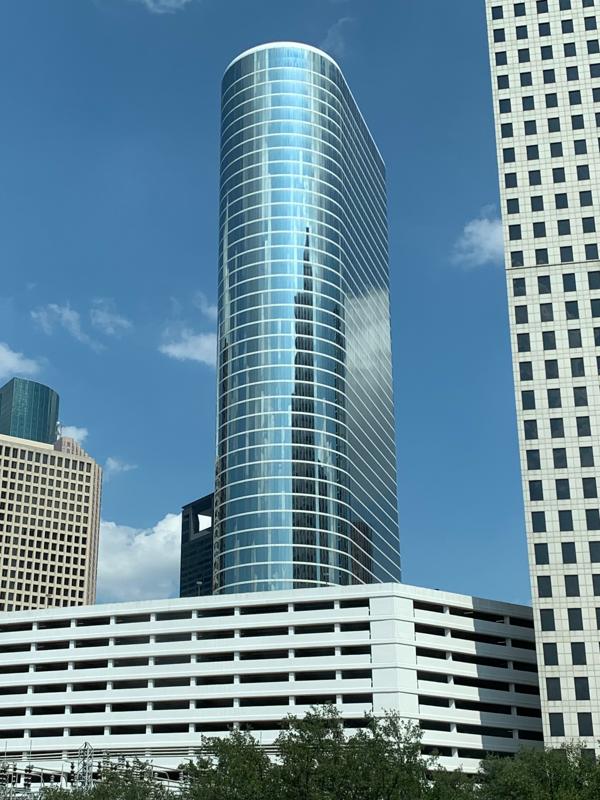
1400 Smith Street, the former Enron headquarters in downtown Houston
©Dewliter (CC BY-SA
4.0)
Kenneth Lay was the CEO Watkins sent her memo to. A jury convicted him on six counts of securities and wire fraud in May 2006. He died of a heart attack on 5 July 2006, before sentencing. A federal judge later threw out the conviction. The reason was a rule called abatement ab initio. It wipes out a conviction when the defendant dies during a pending appeal. Jeffrey Skilling was the chief operating officer. He briefly served as CEO, then quit four months before the bankruptcy. He served twelve years of a reduced fourteen-year sentence. He left federal custody on 21 February 2019. His supervised release ended in February 2022. In 2020 he helped launch a small oil-trading platform, Veld LLC. It was pulled from the Texas business registry in August 2022. He has kept a low public profile since.
Andrew Fastow was the CFO. He built the off-the-books partnerships Watkins flagged in her memo. He served roughly five years of a six-year sentence and was released in 2011. Since then he has worked the corporate-ethics speaking circuit. He talks to MBA classes, audit committees and compliance conferences. His topic is how he talked himself into what he did. In 2025 alone, his listed talks included Ivey Business School, HighRadius, GBQ Partners and Zimmer Biomet.
Arthur Andersen was the auditor that signed Enron's books. It fared the worst of all. A jury convicted the firm in 2002 of obstructing justice. The charge was shredding Enron-related documents. The verdict effectively destroyed it. It cost roughly 28,000 U.S. jobs. The Supreme Court threw out the conviction in 2005 in Arthur Andersen LLP v. United States. The Court said the jury instructions were faulty. But by then there was no firm left to revive. Two decades later, ex-Andersen partners have rebuilt the brand. A tax-advisory practice founded by former partners took the Andersen name in 2014. On 17 December 2025 the parent company, Andersen Group, went public. The stock-market listing valued it at about 2.6 billion U.S. dollars. The reputational risk to an auditor did not end with Andersen. Decades later, the KPMG Australia scandal cost a Big Four firm its CEO and chair after a whistleblower exposed the misuse of a client's confidential papers.
 WeMoral - whistleblowing software
An anonymous, encrypted whistleblower reporting channel for your employees, suppliers and customers, with case management, the 7-day and 3-month deadlines, and audit logs. Be compliant with the whistleblowing laws that apply to you, in minutes.
Sarbanes-Oxley and the law that came out of Enron
The clearest legacy of Watkins' memo is the Sarbanes-Oxley Act of 2002. Congress drafted it in the months after Enron's collapse. It rushed the bill through alongside the WorldCom scandal. The law remade corporate governance for U.S. public companies. It required independent audit committees. It made the CEO and CFO sign off on internal controls. It set criminal penalties for shredding evidence. And in section 1514A, it gave a new right to workers who report suspected securities fraud. They could now sue in federal court. Watkins was named again and again in the Senate hearings that produced the bill. Section 1514A gave later workers the very protection she had lacked. She had none of it when she walked into Kenneth Lay's office in August 2001.
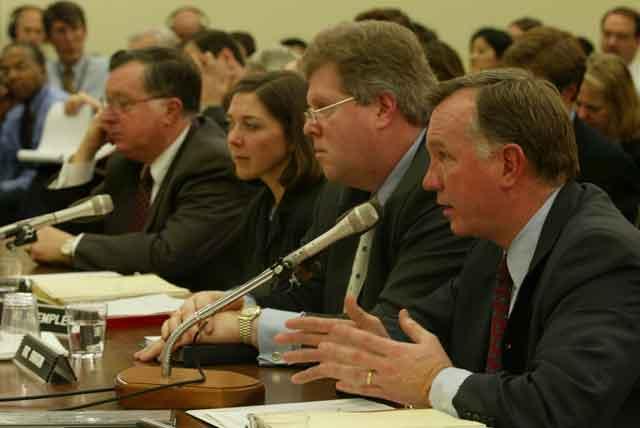
Arthur Andersen executives sworn in before the U.S. House Subcommittee on Oversight and Investigations, 24 January 2002 (US federal government work, public domain)
Those protections grew stronger on 8 February 2024. That day the U.S. Supreme Court decided Murray v. UBS Securities, LLC. All nine justices agreed. Justice Sonia Sotomayor wrote for the Court. She held that a Sarbanes-Oxley whistleblower has to show only one thing. The protected activity must have helped cause a bad job action. The worker does not have to prove the employer meant to punish them. Once the worker shows that, the burden flips to the employer. The employer must then prove it would have taken the same action anyway. It must do so with clear and strong evidence. The decision matters because the appeals courts had split. They could not agree on how high the worker's bar should be. Murray now makes SOX retaliation suits easier to win than most other federal claims.
The 2024 relaunch: Enron as parody
On 2 December 2024, a website at enron.com said the company was back. The date was the 23rd anniversary of Enron's bankruptcy filing. The site claimed it was set on solving the global energy crisis. It came with a polished launch video, a careers portal and social-media accounts. There was even a full-page ad in the Houston Chronicle. The person behind the stunt was Connor Gaydos, a 28-year-old. He had co-created the satirical Birds Aren't Real movement. He had also quietly bought the Enron trademark in 2020. It cost him around 275 U.S. dollars, through an Arkansas holding company. The site's terms of use call everything on it parody and performance art, protected by the First Amendment and for fun only.
The bit kept escalating. In January 2025 Gaydos's Enron held what it called its first earnings call in 25 years. Later that year it announced the Enron Egg. The Egg was a fictional 10,000 U.S. dollar at-home nuclear reactor. It was said to run on a made-up fuel called Enronium. By July 2025 The National reported more. Gaydos was seeking approval to become a retail energy provider in Texas. In September 2025 Bloomberg ran a long feature on the project. It called the venture a financial mess of its own. Gaydos was photographed taking a pie to the face outside a New York event in December 2024.
Watkins herself did not object. She spoke to KPRC-2 in Houston in December 2024. She said the joke "helps to bring to everyone's attention how these things happen and to be aware of the warning signs so that it doesn't happen again," and added that ex-Enron colleagues she had spoken to were "mainly amused." Not everyone agreed. Diana Peters was a former Enron employee who later worked on the bankruptcy. She called the relaunch "a pretty sick joke" and said it disparaged the people who had actually worked there.
Enron's long shadow over modern fraud cases
Two decades after the bankruptcy filing, the Enron template still shapes the story of new corporate frauds. Prosecutors and journalists still reach for it.
Theranos and Elizabeth Holmes are the closest recent parallel. A jury convicted Holmes in January 2022 on four counts of investor fraud. She reported to the Federal Prison Camp in Bryan, Texas on 30 May 2023. Her sentence ran 11 years and 3 months. The Ninth Circuit Court of Appeals upheld her conviction and sentence in February 2025. Bureau of Prisons records put her release around 2032, after good-conduct credits. As with Enron, the case produced a bestselling book, a podcast, a streaming series and a feature film. And as with Enron, the downfall started with an internal report. It came from a younger employee, Tyler Shultz, who raised his concerns at a heavy personal cost.
The other obvious comparison is Sam Bankman-Fried and FTX. On 28 March 2024 a federal court in Manhattan sentenced Bankman-Fried to 25 years in prison. A jury had convicted him on seven counts. They included wire fraud and money laundering. The court ordered him to forfeit 11.02 billion U.S. dollars in assets. The bankruptcy went to John J. Ray III. He was the same lawyer who had run Enron's bankruptcy estate two decades earlier. In his first appearance before a House committee, he said something stark. He had never seen such a complete failure of corporate controls. Coming from him, the comparison did most of the work.
Legacy of Courage
Watkins' actions changed how U.S. corporate governance and financial rules work. The Enron scandal forced through new rules on transparency, oversight and accountability. And Watkins is still doing the work. She is now in her mid-sixties. She is a Senior Fellow for Ethics and Policy at Whistleblower Network News. She is also an Executive-in-Residence at the McCoy College of Business at Texas State University. And she is a Professor of the Practice at the UNC Kenan-Flagler Business School. She lectures and writes about corporate ethics. On 7 March 2025 she joined the Congressional Whistleblower Caucus on Capitol Hill for a fireside chat on new whistleblower legislation.
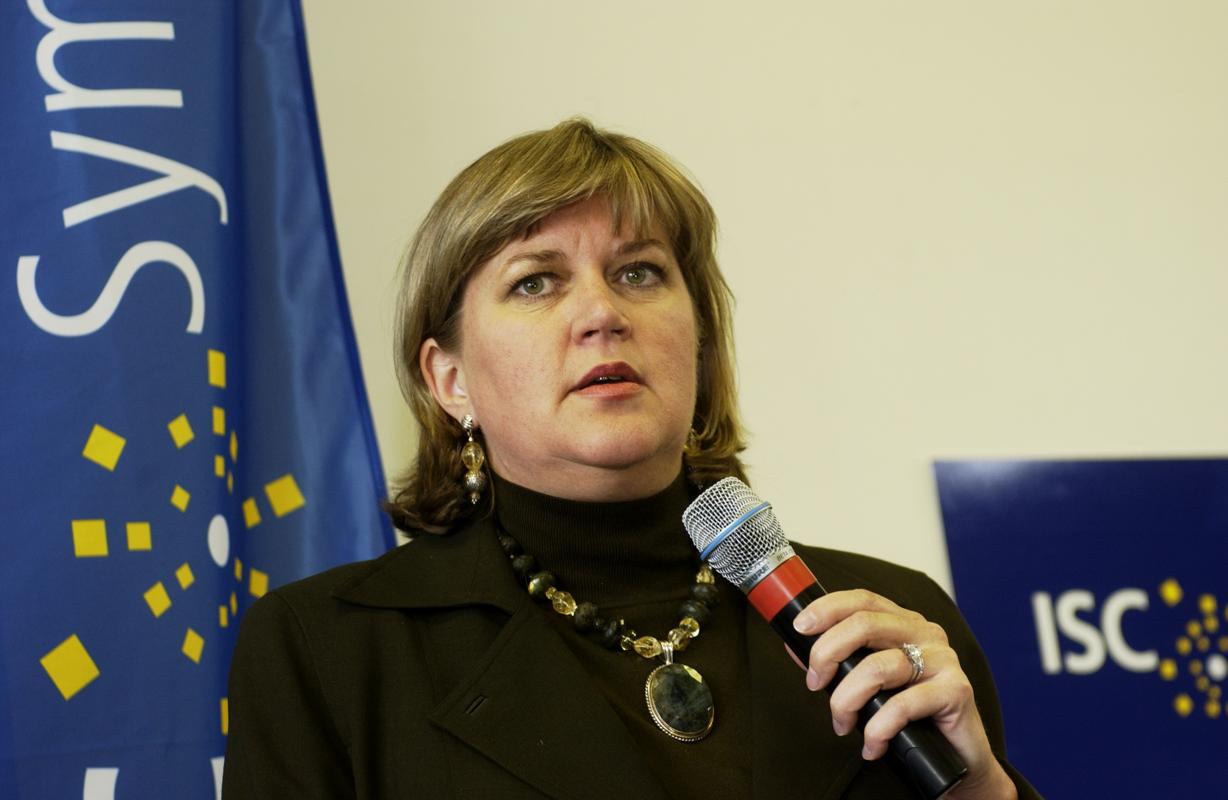
Sherron Watkins at the 34th ISC Symposium, St. Gallen, May 2004
©Regina Kühne /
Universitätsarchiv St.Gallen (HSG) (CC BY-SA 4.0)
Watkins' role inside Enron and the months around her memo appear in several books:
- "Power Failure: The Inside Story of the Collapse of Enron" by Mimi Swartz and Sherron Watkins herself. Watkins co-wrote it. The book shows how the company looked from the inside. It also shows how the fraud came apart.
- "The Smartest Guys in the Room: The Amazing Rise and Scandalous Fall of Enron" by Bethany McLean and Peter Elkind. It is the standard outside account of Enron's rise and fall. It covers the financial schemes, the inside culture and the key people. There is also a 2-hour documentary movie based on the book.
Enron has also kept its grip on stage and audio. Lucy Prebble's 2009 play Enron dramatises the company's rise and fall. It tells the story through mark-to-market accounting and the LJM partnerships. The play was revived at Quantum Theatre in Pittsburgh. The run lasted from 30 October to 23 November 2025. McLean and Elkind's Smartest Guys in the Room has had a fresh run too. It returned to the corporate-ethics podcast circuit through 2024 and 2025. The episodes are aimed at compliance officers. Many of them were in school when the original scandal broke.
Together these books, the play and the podcasts keep the case alive. They put it in front of the next generation of accountants, lawyers and auditors.
Conclusion
Sherron Watkins exposed the Enron scandal at a hard moment. Corporate America then had very little oversight on accounting fraud. Her choice to write the memo did more to change those rules than any single law before it. Twenty-five years on, the safeguards we have today exist because she wrote the memo first. They include Sarbanes-Oxley, section 1514A, and the Murray contributing-factor standard. They also include a basic expectation: a vice president can walk into the CEO's office with bad news and survive it. The 2024 parody, the FTX sentencing and the Theranos appeal each carry a reminder. The conditions that produced Enron have not gone away. And the warning Watkins put in writing in August 2001 is still load-bearing.
Sherron Watkins and Enron: frequently asked questions
Who is Sherron Watkins?
Sherron Watkins is the former Enron vice president who warned the company's chairman that Enron was built on accounting fraud. In August 2001 she wrote a memo to Kenneth Lay predicting Enron would "implode in a wave of accounting scandals." Time magazine named her one of its 2002 Persons of the Year for it.
How did Sherron Watkins expose Enron?
She did not go to the press or to regulators. She wrote an internal memo to chairman Kenneth Lay in August 2001 and met him in person. Her warning became public only when a congressional committee released the memo on 14 January 2002, after Enron had already collapsed.
Was Sherron Watkins a whistleblower?
Yes. She is widely seen as one, and Time honoured her as a whistleblower. But there is a caveat. She raised her concerns inside Enron, not with the SEC or the media. The memo reached the public only when investigators released it.
What was Sherron Watkins' role in the Enron scandal?
She reviewed the off-the-books partnerships and saw that the Raptor hedges would collapse onto Enron's books. She then put the warning in writing to the one person who could act on it. She is often called the moral voice of the scandal because she named the fraud while executives were still denying it.
Did Sherron Watkins go to jail?
No. Watkins was never charged with any crime. The executives she warned about were prosecuted instead: Kenneth Lay was convicted, Jeffrey Skilling served twelve years, and Andrew Fastow served about five.
What happened to Sherron Watkins after Enron?
She left corporate finance and now teaches and writes about corporate ethics. She is a Senior Fellow for Ethics and Policy at Whistleblower Network News. She also holds teaching posts at Texas State University and the UNC Kenan-Flagler Business School.
Compliance specialist focused on policy roll-out and internal information flow. Writes on EU rule-making, landmark cases, and implementing reporting software.